
The Tools Getting Me Through Quitting Weed
Thirteen weeks ago I stopped using weed, after more than twenty years of it. I've written about how I got here - from a nightly joint through the Social Bite years, to a month of stopping that nearly broke me, to a long taper with Crew 2000 and eventually a little edible every evening - in Twenty Years of Weed, Thirteen Weeks Without.
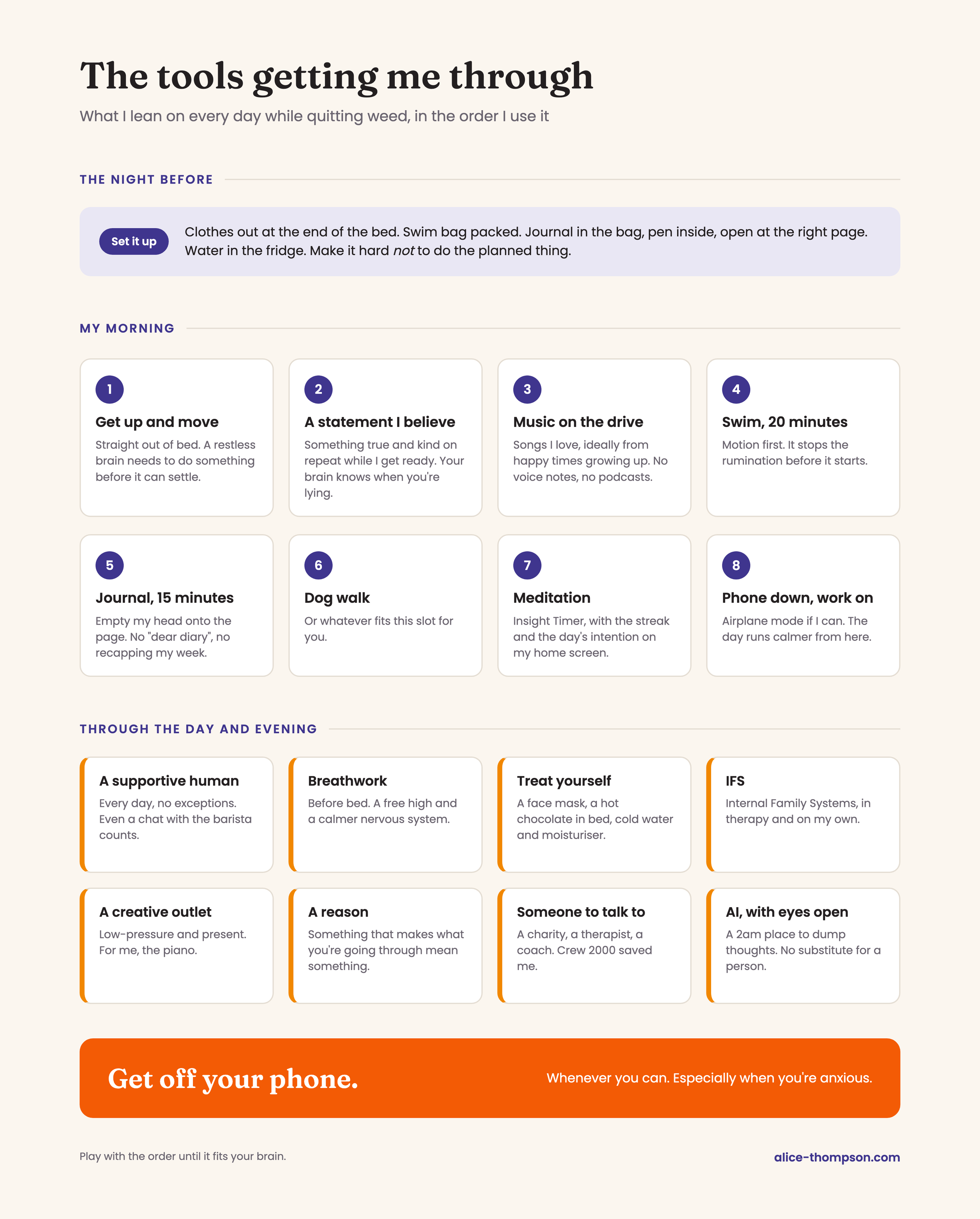
This post is the practical part. These are the tools I've leaned on hardest over the last thirteen weeks, and they're some of the same ones I take my clients through when they're struggling the most.
This is what works for me, in this order. None of it is new. But if you suspect you might have ADHD, or you're struggling right now or trying to white nuckle getting off weed, or your phone, or whatever your crutch may be, you might look at this and wonder whether one of these things, or a combination in a different order, could work for you. For professional addiction and mental health support see links at the bottom of this page.
My advice is to play with it. At first I started with ‘Morning Pages’ first thing when I woke up, and it didn't work for me. It started eating my morning, I found it hard to stop in good time, and by the time I got to the pool it was busier and harder to find space in a lane. You have to play with these things until you find your own routine.
My morning
1. Get up and move, straight away. I get up and go to the pool to swim immediately. (Let's acknowledge right here that having a pool to go to is a privilege.) I've learned from psychiatrist and neuroscience whizz from Harvard Medical School, Dr Alok Kanojia, that for people with ADHD, trying to contemplate or do slow, meditative practices first thing is no good. It's a mind that needs exercising by doing something active straight away(ideally something meditative but active), so it can settle later when I need to focus. Getting out of bed and doing something like swimming very early, before my day has to start, has been a game changer. It’s one stroke at a time. And crucially, it has to be something I want to do.
2. A positive statement swirling in my head while I get ready. I need a positive statement about myself going round my mind to programme my neural circuitry for a good day. I take clients through a process to find out what they need most at this time of day, because the mind is so vulnerable and suggestible when we first wake up due to the theta brainwave spectrum our brains are operating at when we wake. It's essential that the statement is one you believe to be true about yourself, or the whole thing breaks down neurologically. Your brain knows when you're lying. So once you have the right statement, it takes no time and you can repeat it in your head on the move. These are the hacks I like - the ones that don't require you to become a morning person or change your whole personality to implement them.
3. Music on the drive. I get into the clothes I've left waiting at the end of the bed, grab my pre-packed swim bag and the bottle of water I left in the fridge, and take the five-minute drive to the pool, playing music that lifts my mood. Music is an essential part of this.
I used to listen to a friend's voice note, or reply to someone hands-free, on that drive. That was a big mistake. This is supposed to be ME time, and on top of that, it lets my mind and emotions get led down whatever path that relationship or podcast is going down. At this crucial time of day, when our brains are so sensitive and suggestible, what I need - and what we all need when we're struggling - is an injection of feel-good chemicals. Music we love helps release serotonin.
Music from your childhood or adolescence is often a winner here, because it gives you even more of that boost. One client told me it was too emotionally overwhelming for him. Then months later he came back and said he'd just been listening to the wrong stuff - songs that reminded him of hard times at high school. When he switched to music tied to safe, happy memories from when family life was good (another privilege I hope you've had some experience of if you're reading this), suddenly Paul Simon had him tapping his fingers and feeling a slight lift after all. If you really don't have good feelings tied to any music from when you were younger, choosing something you love now is great.
4. Twenty minutes in the water. That's it. Twenty minutes of swimming. For me, personally, this is the best way to get things started and stop the rumination. I can't journal well until I've done something that feels like motion.
5. Fifteen minutes of brain-dump journalling. Then I sit in the lounge at the Bannatyne and journal for fifteen minutes. It's usually hard to stop when the timer goes off, but I try to wrap up so it doesn't leak too far into the morning.
This is where I dump every thought in my brain. There's no "dear diary," no chronicling my daily activities, no catching my diary up on what's happened since I last wrote. That style of journalling feels like a burden to me. It makes me the movie director of my own life, leading me down self-righteous rabbit holes that strengthen unhelpful convictions and bring no relief. Instead I just empty my brain in a running stream of consciousness.
Julia Cameron, author of The Artist's Way, calls this "morning pages," and she encourages people to do them as soon as they wake up. But as I've said, not every rule applies to every brain. What I've worked out about my (potentially ADHD) brain is that it needs to do this after some active time, or it can get really depressed first thing, falling down half-conscious, just-woken rabbit holes.
Then I head home, music on again.
6. The dog. I take my dog out for his morning toilet and a little run around. If you don't have a doggo right now, this is the slot for whatever works for you.
7. Meditation. I come back and do a meditation on Insight Timer. I cannot recommend it highly enough. It's no Headspace, thank god, and it actually works for me. I downloaded their widget - actually two of them (I did say this is for desperate times, right?!) - so I can see on my phone how long my streak has been going, and what intention the app helped me set for the day. I usually go with whichever intention it suggests for the meditation I chose, but you can write your own.
8. Off the phone, and into the day. Once I'm done with the meditation app, I sometimes put my phone on airplane mode. If I have time I might reply to my best friend in Canada or a family member, but usually it's time to start work. My day runs so much more peacefully, and from a better starting place, when I manage to do all of this first.
9. Get off your fucking phone
There's no other way to put it. You know it, I know it, I can't labour the point enough. Whenever you can, abandon it. Try turning it off. Suddenly your life is yours again. Read a book, make something, go for a walk, play an instrument, watch a film without it distracting you, meet someone in real life and turn it off once you're with them. There is little in this world better for your mental health than getting off your fucking phone. ESPECIALLY when you're anxious.
10. The night before
None of the morning happens if I don't set it up exactly right the night before. I'm essentially sheepdogging myself into the thing I want to do first thing. I pack my journal in my swim bag with the pen inside, open at the page I'll write on when I get out of the pool. I lay out all the clothes I'm going to wear, and pack fresh pants and socks for after the pool. The further you take this the better. Make it actually hard NOT to do the planned thing the next morning.
The rest of the day and the evening
11. A supportive human, every day, no exceptions. Whether it's your partner, your best friend, your mum, a neighbour or your aunt, the single most important thing is to have someone supportive to lean on who understands that you're going through a hard time. Ideally, ask them how they feel about being that person for you during this part of your life.
It doesn't have to be one-way. Make sure you don't take up all the airtime - check in with them too, so you know what their capacity is like that day, and so you can return the favour if they're having a tough one themselves. Misery loves company, as the saying goes, though I mean it more kindly than it sounds. Sometimes there's no better way out of your own head than focusing on what someone else is going through. We're social creatures, and even the most introverted people benefit hugely from connection. Researchers found that simply having a brief, friendly chat with the barista when buying a coffee lifted people's mood and sense of belonging (Sandstrom & Dunn, 2014), and a follow-up study found people were happier on days they had more of these small interactions with acquaintances, however extraverted they were (Sandstrom & Dunn, 2014).
So whether it's a deep connection (ideal) or just a routine where you know you'll have contact with another real human that day, having someone witness your life is essential.
12. Breathwork. This has been essential for me. I've trained in it, and I've done it at workshops as something fun, but I've never benefited from it like I have recently, when I'm actually struggling. Not to mention it's a free high! I love doing it before bed, and there are countless free videos on YouTube that will guide you into a relaxed, serene place before sleep. I particularly like this one from Breathwork With Sandy, and there are plenty of others, including longer ones that go even deeper.
13. Treating myself. I treat myself however I can with the time I have in the evenings. Lately I've got the red light mask out again after months of ignoring it, and I've been doing a dialled-up skincare routine. That won't be relevant for everyone, and these are luxuries not everyone has. Hot or cold water on your face and a basic moisturiser before bed might be all you need to feel like you've proactively done something for yourself. Whether it's a face mask, a hot chocolate in bed or the high from a breathwork session, this is the time to indulge yourself however you can.
14. IFS - Internal Family Systems. IFS has changed my life. I see my therapist for it, I'm qualifying in it, I read about it, and I use it on myself whenever I remember to (because we're all humans who get triggered by life, and we don't always remember the most helpful tools in the heat of the moment!).
15. A creative outlet. Something mindful and low-pressure: a colouring book, slam poetry, cooking your favourite meal from scratch, or just picking up a new book. I've taken up the piano again, though I don't always convince myself to sit down and practise after a long day, a dog walk and making dinner. But you need something that reminds you what being alive and present in the moment feels like when you're not stuck in your head.
16. Finding meaning. This isn't simple, and it's different for everyone. I couldn't possibly tell you what's meaningful for you, but we need to believe in something, in the future or the present, that makes what we're going through mean something. It might be a sense of belonging in your community (however big or small), getting well so you can be there for someone else in future, using your creative energy to build something that will outlast you, working towards a job you care about, a fitness or strength goal - or, like me right now, knowing the reason I'm going through all this is to see if I can have a baby. There needs to be some kind of reason behind it.
If you really can't figure this out on your own, you wouldn't be the first. Speak to someone. If you can't afford a therapist, coach or other support, look at what charities offer in your area. Crew 2000 was a lifesaver for me in Edinburgh when I needed it most.
17. And yes, AI. Let's not ignore the obvious. Everyone's using it now, so there's no point pretending it isn't a resource. I'm not worried about it replacing my job - I use it myself to quite a sophisticated level - but connection with a robot isn't the same as being witnessed and accepted by an actual human. Still, people can't be at our beck and call 24/7, so if you're in a tough stretch of your life and need support, AI is a decent place to dump your thoughts (depending on how comfortable you are with the tech overlords having access to your innermost thoughts, of course - everyone has their own view on this, but it's there if you're OK with it, and can be surprisingly sophisticated it’s responses if you know how to use it and give it healthy instructions for how to reply to you.
If you're in the UK and struggling with cannabis or any other substance, Crew 2000 (Scotland) and Talk to Frank (UK-wide) offer free, confidential, non-judgemental support.