
Twenty Years of Weed, Thirteen Weeks Without
What I'm leaning on most right now
If you're struggling and you only read one bit of this, read this bit. These are the tools I've been using every single day for the last thirteen weeks, and the same ones I take my clients through when they're in a hard patch. None of them are new. All of them are free or close to it. I've written up exactly how I use each one in a separate post, so this one can be about how I got here.
Moving my body first thing. Twenty minutes in the pool before anything else. A restless brain needs to do something before it can settle.
A morning statement I actually believe. Your brain is at its most suggestible when you first wake up, so give it something true and kind to chew on - your brain knows when you're lying to it.
Music I love on the way. A cheap, reliable hit of serotonin, and music from your teens or childhood (the happy bits) works even better.
Brain-dump journalling. Fifteen minutes of emptying my head onto the page after the swim. No "dear diary," no recapping my week.
A meditation app with a streak. Insight Timer, plus two widgets on my home screen so I can see my streak and my intention for the day.
Getting off my phone. I'll spare you the polite version.
Preparing the night before. Clothes out, swim bag packed, journal open at the right page. Make tomorrow-morning-you's choice for them.
A supportive human, every day. Someone who knows you're going through it - and even a chat with the barista counts.
Breathwork before bed. A free high and a direct route into a calmer nervous system.
Treating myself. Whatever is available - a face mask, a hot chocolate in bed, five minutes of proper skincare.
IFS (Internal Family Systems). The approach that has changed my life more than any other, in therapy and on my own.
A creative outlet. Something low-pressure that drags me out of my head and back into the moment. For me right now, that's the piano.
A reason. Something that makes what you're going through mean something.
AI, with eyes open. A place to dump thoughts at 2am when no human is awake to hear them - no substitute for a person.
The journey so far
From stoner to recovery, and the long search for something else
It shouldn't come as much of a surprise to anyone who's met me, or watched my work from the outside, that I've been a stoner for all of my adult life. Nor will it surprise most people to learn that I'm not the kind of coach who claims to be the perfect example of how to live. Honestly, I think the coaches who make themselves into gurus can do real harm to a client's sense of self.
What I do instead is educate myself, endlessly, on how people get to the things they long for most and what really holds them back. I research, and I keep updating as new information comes along, whether that's from research, from my own life or from my clients' (there's no replacement for lived experience, in my view). I try the tools out on myself first. I bring back what works, and I offer alternatives to clients who might respond better to other things depending on their Enneagram type (i.e. are they a doing, feeling or thinking type?).
I'm honest about being a work in progress, and it's taken me a long time to run my practice this way. I used to think I was supposed to have all the answers for all of my clients. I've learnt that's impossible, and that a client has to be willing to look at what matters most to them, and explore it with me, for me to have a fighting chance of helping. And as my supervisor says my practice has “matured” in that process of moving from just qualified and thinking i’ve got the answers, to more experienced practitioner who recognises what is most helpful for people is not being told what to do.
So here we go, my big unconventional, truthful struggle.
The wholesome stoner
I drank a lot in my early twenties, but the older I've got, the less alcohol does for me except bring on a depression and a hangxiety that really aren't worth it. So I barely drink these days. Being a highly productive, self-motivated professional who was a stoner by night felt like a much more functional and healthy way to live than the way I watched so many people drink in society at large. So I felt quite self-righteous about my little reward at the end of each hard day's work: a weed edible, or a hot chocolate with a little chocolate edible melted into it. It felt so wholesome. It still looks that way to me, I won’t lie.
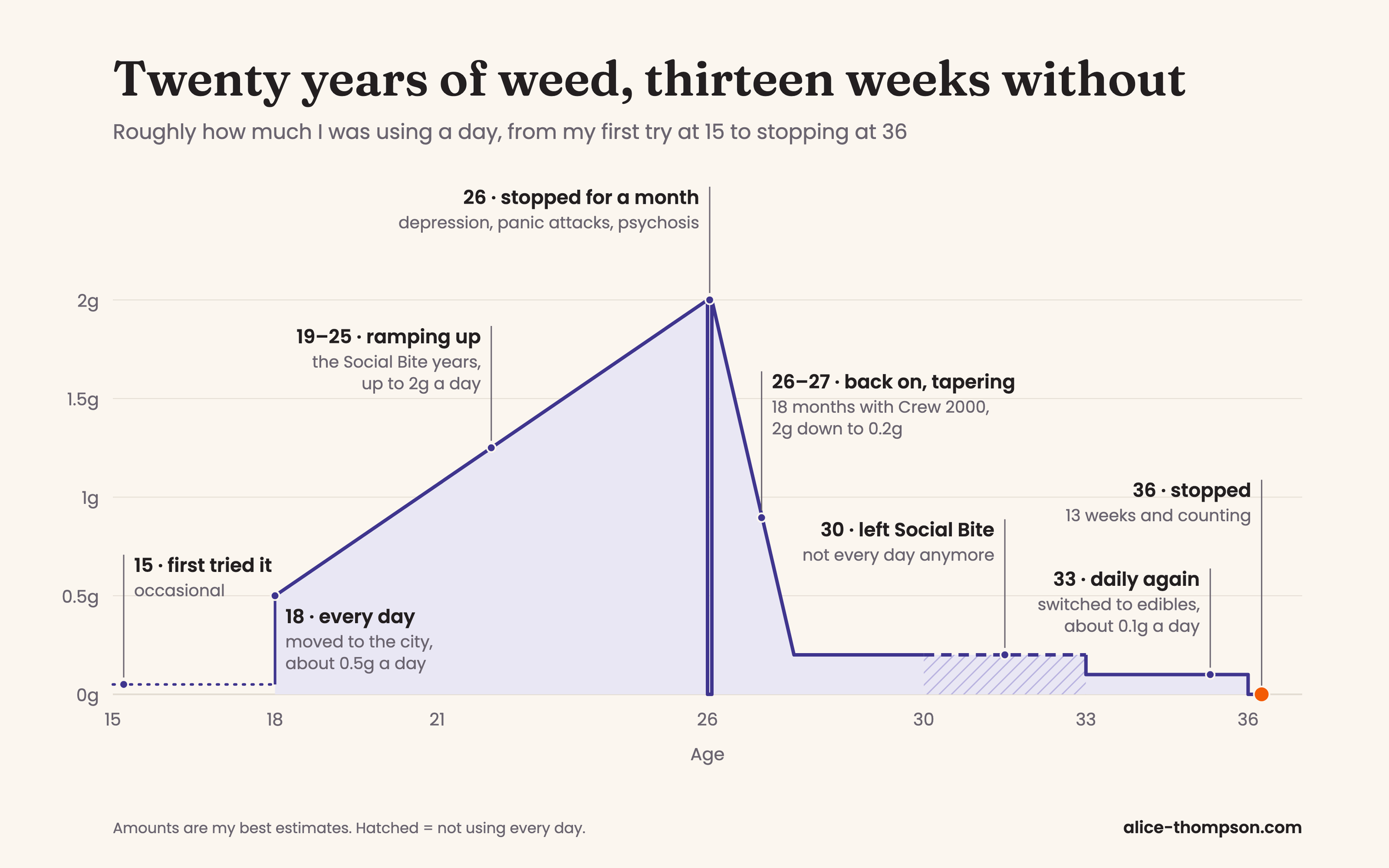
But this has been a journey since I was fifteen, when I first tried it, and eighteen, when I moved away from my family home in the rural highlands of Scotland into the city, and could pick up every day with ease.
Faking it until I made it
At nineteen I dropped out of university and took an unpaid internship to prove to my parents I had some kind of plan beyond dodging exams. The company was a fledgling events business run by a young guy in his early twenties, just out of uni himself, with no money to pay staff. So he hired three-month interns in exchange for meaningful work experience, plus 10% of whatever we sold. Everyone needed that experience. From the early noughties onwards, graduates suddenly ALL had the same degrees from good universities, and in a field like events management practical experience was everything.
When my parents made clear what I already knew - that they couldn't financially float me if things didn’t pan out but I’d always be welcome back at home (I didn't come from a wealthy background, but moving back to the highlands was about as appealing to me as metal forks in my eyes) - it was the first time in my life I had to find some semblance of independent living and back myself in a way I never had before. Financially, yes (I was used to working a part time job, but I wouldn’t have a student loan anymore), but mainly emotionally, in terms of my confidence and conviction to live my life my way. Fake it till you make it became my way of life for years, and it started here. I leaned on weed big time through that transition for the chill, every-little-thing-is-gonna-be-alright energy that I needed to will into my existence.
Before my three months were up, this guy who’d hired me as an intent asked me to stay on and help him turn the business into something brilliant. He offered to make sure my rent was covered, and said I stood to make a lot more money if I sold well. It wasn't exactly a lie, but at nineteen I didn't have the networks, the training or the business acumen or maturity to make the most of that opportunity. But when I made a sale, nothing felt as good as getting a few hundred quid dumped into my account at once. I thought I was rich every time. But of course, I wasn’t…
So I survived by going into a bit of debt during that time. It actually worked out quite well in the long run, though stressful at the time. When I paid it off much later at age twenty-nine, the credit agencies took me from red to green, and I've had the best credit rating ever since from paying it off and staying afloat (nothing like debt to scare you into staying liquid). The system is mental. I've been rewarded by the financial assessors for being totally irresponsible with money when I was younger, while my peers who never got into debt and have earned a stable income since uni have worse ratings than me. One of life's ridiculous little things.
Social Bite, and the dysfunctional family
That events business led to the founding of Social Bite when I was twenty, and to our first shop opening when I was twenty-one. By twenty-three I was running nine locations, including a central production kitchen with a night shift that made us a 24-hour operation where problems could crop up at any hour. I had 110 employees who had my number to call when shit hit the fan - and it did, often. Especially when we took on big corporate catering gigs we weren't trained or prepared for, but had to accept when he sold them to whoever would take us, just to keep the business afloat.
Did I mention we were hiring people who had been homeless and trying to help them change their lives too? Oh yeah, and I lived with our first two employees from the homeless community, so there was no escape for a while. To be fair, that was the least of my problems. I grew to love living with them, and the reckless way we all worked and banded together. When nobody else wanted to stay and help me crack some classic hospitality problem, or a last-minute order for 150 people that landed just as most people's shifts ended, those two guys who lived with me had my back. I wasn't alone in it because of them, I cried with them and sharing cigarette breaks with them, even if they'd sometimes storm out yelling, or bring sex workers back to my place drunk at 2am.
We were a dysfunctional family, and I had weed every night to take the edge off how lonely I felt.
It was a lot for someone with likely undiagnosed ADHD (I'm awaiting my diagnosis at the end of this year), and with intense attachment needs. I'd do whatever it took to be indispensable to my friends, because connection felt like safety, and safety felt like survival. The Enneagram calls this the social instinct: A tribal need for group survival, “your survival is my survival”. Weed became how I masked the emotional dysregulation that came with relationship troubles, and above all how I coped with the immense pressure of work in a start-up that wouldn’t stop scaling or garnering public attention and celebrity appeal.
Stopping, the first time
At twenty-six, life finally settled down a bit. I had more space from the business, and I was in a loving relationship that met my needs in a way no one ever had before (don't worry, I married him!). It was time to look at the dependency I'd built up, smoking weed every evening of my life to feel good, to reward myself at the end of a hard day in a world that didn't make sense to me, and to decompress from everything the world demanded. Every night it felt like taking my mask off and taking a breath of fresh air… ironically.
I had always told myself I could stop if I wanted to. But why would I want to? My boyfriend challenged me to just try, suggesting I was more attached than I realised, so I set out to PROVE to him that I could.
I stopped completely for a short time. But it wasn't simple. He had to come over and physically remove the box of weed and joint-rolling kit I owned so I couldn't get to it, and then he had to stay with me all night while I cried. I had no idea it would be like that. I was shocked at my own reaction. And then we repeated that every night for weeks.
That was the beginning of a much longer journey. I spent the next four weeks abstaining, getting more and more depressed, having panic attacks every day, and wondering what the point of living even was without feeling ok ever, which the weed had been giving me. I couldn't go to work anymore. That was the last thing I could cope with - the pressure and expectations inside that organisation at that point were relentless, necessary for its survival, but life-draining for me. I also lost all sense of connection to Social Bite. Without weed I had no desire to be involved. Social Bite and everything to do with hung over me like a dark cloud of hectic mess that I wanted total distance from.
When things got really bad, my partner and my best friend basically pleaded with me that for the sake of my safety and for the sake of keeping me alive, I should just have some weed again, and we would figure out how to get me off it with professional support going forward. The first spliff I had after 4 weeks of misery made my whole body sigh in a way I didn’t know possible. I had no idea weed could suppress trauma or feel like this level of relief when it comes back into your body. I owe my life to my now husband, Jamie and best friend Charlotte for that evening and the permission they gave me to go back to it.
Crew 2000, pill boxes and a crutch
From there I started counselling with an incredible Edinburgh organisation called Crew 2000, who offer free drugs counselling. I worked with them for months. It was the only thing I'd leave the house for, and I didn't always make it.
Over about a year and a half I weaned myself down from 2g a day (about five popcorn-sized buds in the palm of your hand) to 0.2g. Jamie used to weigh it out for me and put it in pill boxes. Then I more or less stayed at that level until recently.
As time went by, I started to talk about it more openly, including with the coach I'd sought out to help me when I went back to work at the organisation I'd worked so hard to create. Her feedback has stayed with me ever since. She said, "That sounds like a crutch... you don't kick people's crutches out when they don't know how to walk yet."
There was no judgement from her. I hadn’t expected that. Instead, she encouraged me to believe that once I'd taken the things that made me unhappy out of my life, and built a life I found more fulfilling, I might be able to go whole nights without weed. Then maybe more than one night a week, and on from there. The crutch might fall away when I didn’t need to lean on it so hard. What an incredible intuition she had about this subject she had zero training in - sometimes humans come into your life at just the right moment.
Leaving
So I started planning. I knew I had to leave Social Bite. It had done incredible things, and it had been an enormous part of my life, my identity and the confidence I'd built as an adult (even if I lost parts of that confidence along the way). But it was time to release myself from my anxious attachment to its success, and to the powers that be - the co-founder, the board, the staff. I'd become beholden to so many people. I didn't know how yet, but I knew I would leave.
When Covid struck and the world went indoors, and the politics and headaches at board level got worse than ever, it became clear that it was time to get the hell out of there. The therapy with Crew 2000 had made me strong enough to massively cut down and to get back into full time work, and the coaching had given me the nudge to believe I could one day have a different kind of professional life all together.
I left with a broken heart. It had broken me in so many ways, but it was also all I had of a career. I didn't have a degree like my peers, and I had no direction. I just knew I couldn't be there anymore. I was immensely privileged and lucky to have a partner who said he'd keep a roof over our heads, just about, while I got myself up and running again financially.
So I retrained as a professional coach and mentor, and started working with clients who knew me from Social Bite's success. I had been so supported by the coaching space that I wanted to provide that liberation for someone else. I found myself supporting people through problems I'd been in a hundred times myself in business. Helping others strengthen their approach showed me how brilliant I'd become at sales, and I discovered I had an eye for marketing and even for making good financial decisions (something I'd never credited myself with at Social Bite but was nonetheless around all the time). Social Bite taught me so much I hadn’t realised while I was there feeling so trapped I couldn’t see what a weapon I’d become, but my own experience of burnout, of ignoring my intuition and finding my way back to myself, of resilience, was more valuable than any coaching training could have been. Although I'll say this - the 6 months of coaching training and assessments gave me something to focus on, and I needed that while I licked my wounds in 2020 after leaving Social Bite.
And after a year or so, once my coaching business was up and running and I wasn't relying on Social Bite anymore, I found I could go a night without weed. Then eventually, two nights in one week. I felt liberated standing on my own two feet, away from the person I'd leaned on since I was nineteen and built Social Bite with, and away from an organisational structure that left me no room to breathe. Finally, some peace.
The switch to edibles
As time went by, though, the habit crept back, as all habits and coping mechanisms do. I knew I needed to switch things up again. I didn't feel strong enough to stop altogether, not after how shattering that had been the first time, I needed my brain to remain stable more than ever now that I was using it to build my own free lance coaching business where I was my product. But I knew smoking wasn't good for me. I also knew that the instant relief a spliff gives you meant there was no need to train any other coping mechanisms into place.
Then a friend from Canada gave me a legal edible she'd smuggled back to the UK, and I realised this gentle, gradual high was a much healthier way to go about things. I started making my own edibles at home. That meant I now had to sit with whatever was going on for me that day until the edible kicked in about an hour later, rather than finishing work or the domestic chores and then going straight to it. It gave me a little window of time just being with myself, which I hadn't had much of in my life before.
Eventually, we got a dog. We'd have an edible after work and chores were done, go out for a walk and catch up on each other's day in a way we never could when we used to sit about getting high right after work. Once the high kicked in an hour or so later, we'd come home for dinner. That became the new nightly ritual. It felt healthier, and I was down to about 0.1g a day rather than 0.2g, so it still sort of felt like progress.
Thirteen weeks ago
My husband and I have started to think we might try for a baby, after being fairly convinced we didn't want one. Who knows if we’ll get lucky, and we’re ok with it either way. But as it dawned on us over the last few months that we’d like to give it a try, I realised I’d need to be weed-free for pregnancy and breast feeding. Then some less-than-optimistic hormone results told me we couldn't afford to wait. If there was any chance my mental health would be tough again without weed entirely, I should start riding that wave now, so I'd be in a more stable place when inviting pregnancy into my body and my life, and that had to start ASAP.
So we stopped. Both of us.
It's incredible how differently people experience this. My husband, who used to get anxious or overly self-aware when high, got some social energy and confidence back at work. He stopped lying awake at night worrying about every email he'd sent that day, and started getting up earlier to prepare for his day more consistenly.
To my complete surprise, I coped OK for the first few weeks. Then month two set in and things got hard again. Not quite as hard as the first time in my twenties, but flavours of those feelings have been running like a constant low hum in the background.
This time it's for a reason though, and that gives the misery a sense of purpose and direction in my lowest moments. I'm a purpose coach who has learnt that purpose is really about finding ways to be present, to stop needing to escape your life, to actually be able to meet yourself - and here I am at thirty-six, only now properly facing my biggest shadow and my biggest challenge to purpose yet. It has surfaced everything I thought I'd dealt with, and things I'd packed away and thought I'd never have to look at again. I've found out what it's like to be me in a much more raw and unfiltered way, including seeing the signs of ADHD so acutely that I got myself on the waitlist for a psychiatrist who can do the official testing later this year. I've had to sit and breathe through every uncomfortable moment, every negative thought about myself, every resentful feeling towards myself, other people or the world.
Here I am, one of the top-rated coaches in the UK, with a full diary of clients and a glowing Google reviews page, and I'm still a human going through one of the toughest periods of my life.
But this time I'm coming at it more educated. I became obsessed with understanding what happened to me in my twenties, so I learnt everything I could about our dopaminergic system and understand far more about the brain now. My psychotherapy training, and my general obsession with the Enneagram, attachment theory and how relationships develop, have taught me more than ever about coping strategies and the unhelpful patterns we fall into when we hit a wall, including the way the nervous system will have us do anything BUT the thing we most need to do. And I have tools like breathwork, meditation and journalling protocols that I've been taking clients through for years.
Over the last thirteen weeks I've used every tool and resource I've gathered over the years more than ever before, out of sheer desperation.
So what does that actually look like, day to day? And is it actually working? I've written the whole toolkit up, in the order I use it, in the next post. Take what's useful and leave the rest. Everyone is different, but if anything I’ve got can serve you in your darkest moments then it’ll be worth a glance.
If you're in the UK and struggling with cannabis or any other substance, Crew 2000 (Scotland) and Talk to Frank (UK-wide) offer free, confidential, non-judgemental support.